Kaltura MediaSpace (video.syr.edu)

Syracuse University Kaltura MediaSpace
Log into your Syracuse University Kaltura account:
Table of Contents
Uploading Media to Kaltura
You can use the Kaltura MediaSpace to upload videos and other types of media, organize media into channels and playlists, and then share media and media collections via links and embedding directly into Blackboard. The following uploading options are available:
- Manual Media Upload is for videos you've created with another application that you are ready to put it into Kaltura to stream via the web.
- Kaltura Capture will launch the Kaltura Desktop Recorder, an application that can be installed on your machine to make recordings of your desktop screens or applications and cameras attached to your computer. The recording is created on our computer's hard drive and can be uploaded from the application directly to your Kaltura media library.
- Express Capture allows you to use microphones and cameras connected to your device to record into the web browser and upload it directly to your Kaltura media library.
- YouTube creates a media item in your library based on a video hosted on YouTube. This feature allows you to sort and organize course media in a single location, post to your course with the Kaltura tools, and have YouTube videos play via the Kaltura Player which can remove some ads and provide Kaltura analytics for the item. Please note that the original video source video remains on YouTube and plays through Kaltura. If it is removed from YouTube by the owner, the Kaltura item will no longer work.
- Kaltura Quiz links to a page where you can either select an existing video in your library or upload a new video to use as the basis for quiz built on top of the video. SU users interested in this feature are encouraged to consider PlayPosit which allows you to create interactive videos from the items in your Kaltura media library.
Manual Media Upload
Follow the instructions below to manually upload media you've created with another application that you are ready to put it into Kaltura to stream via the web.
To upload a file manually:
- Log into Kaltura MediaSpace, at the upper right, click the area that says Click Here To Login (
 ), and then select . When prompted, log in with your NetID and password.
 At the top right, click Add New (
 ), and then select Media Upload.
- Drag and drop media as shown on the screen or choose a file to upload.

Kaltura Personal Capture (Desktop Client)
Kaltura Personal Capture is a desktop application that helps you record presentations using any combination of voice, webcam video, screen action, and PowerPoint slides. You can then upload and manage your recordings alongside other Kaltura content in the Kaltura MediaSpace.
To install Personal Capture on your desktop:
- Log into Kaltura MediaSpace, at the upper right, click the area that says Click Here To Login (), and then select . When prompted, log in with your NetID and password.
At the top right, click , and then select .
Note: You may need to expand your browser window to see all available options.- If your browser prompts you to approve the download, select whichever option allows the download to proceed.
- When the download is complete:
- In Windows, click the Personal Capture installer, and then follow prompts to complete the installation.
- In macOS, drag the Personal Capture icon to the folder.
- When the installation is complete, return to Kaltura MediaSpace; then, to launch the software, click , and then select again.
Using Kaltura Personal Capture on a Mac
As macOS increases its privacy and security settings for Apple's operating systems, running Kaltura Capture on macOS may require enabling additional permissions. Please use the instructions found on the Kaltura Personal Capture macOS Settings page if you are seeing errors while trying to record using Kaltura Personal Capture on macOS.
Kaltura Express Capture in KMS
Kaltura Express Capture allows you to record videos from your browser without installing additional software on your computer via Kaltura MediaSpace or via Blackboard. Recent updates include the ability to record your screen as well as your camera to create a dual-stream video where viewers can choose how the streams are displayed to them.
Express Capture is only supported on laptop and desktop computers. It is not available on mobile devices. For mobile devices, use the video camera option on your device and upload the content using the media upload option.
Additional instructions are available from Kaltura.
Important
- Do not use Express Capture to record long videos. Express Capture is a web-based service, so any interruption in internet service could corrupt your recording and it will not be recoverable. Use Express Capture for quick videos that are a few minutes long such as answers to questions, explanations about how to do a homework problem, providing a comment to a discussion, or a short presentation. The maximum allowed recording length is 30 minutes.
To use Express Capture in Kaltura MediaSpace:
Important
- On macOS you will need to /wiki/spaces/ITHELP/pages/159942992.
- On Kaltura MediaSpace, at the upper right, click the area that says Click Here To Login (), and then select . When prompted, log in with your NetID and password.
Click , and then select .
Note: You may need to expand your browser window to see all available options.
- If prompted by your browser, allow access your camera and microphone.
- Click the camera button to turn the camera on and off, or to select the camera to use, if you have more than one attached to your computer.
- Click the microphone button to turn the microphone on and off, or to select the microphone to use, if you have more than one attached to your computer.
- Click the screenshare button to enable screen recording and select a screen or window to record.
- To begin recording, click the red icon.
- While you are recording, the total time is displayed in the bottom center of the interface.
- To end your recording, click the button. You will be presented with three options:
- : Click this to discard your recording and immediately begin a new one.
- : Click this to upload your recording to MediaSpace. After clicking, enter a title, and then click .
- : Click this to download your recording to your computer.
After they are uploaded with the option, recordings made with Express Recording behave like all other Kaltura content. They will be closed-captioned, can be published to Blackboard, embedded to a website, and can be downloaded.
Closed-Captioning
Machine captioning is performed automatically on all videos uploaded to Kaltura (video.syr.edu). This process uses automatic machine generated transcription (ASR) that recognizes the words spoken in your video and provides machine-based captions with 75-85% accuracy.
Live Captioning
While third party speech-to-text products, such as Otter.ai, exist for live-captioning, ITS recommends that professional captioning be used whenever an accommodation is requested or whenever our policy requires that an event has live captioning.
See Guidelines for CART and ASL Interpreting for more information.
Deleting Captions and/or Transcripts
Users can choose to delete captions or transcripts from media.
Allow Time for Deletion
Kaltura may take a few hours to a day to completely remove captions and transcripts from media files once deleted. Kaltura may take a day or so to completely remove the transcript from media files once deleted. If you delete a caption file, we also recommend that you also delete the corresponding transcript file, and vice-versa.
Visit video.syr.edu and locate My Media.
In the My Media page, select Edit (
 ) indicated as a grey pencil to the right of the media.
Select the Captions tab (for captions) OR select the Attachments tab (for transcripts).


Locate the files that you are removing and hit the x (
 ) in the Actions area.
A Delete Confirmation window will pop up. Select Delete (
 ).
). 
Requesting Captions in Other Languages
Media owners can request captions be processed for their videos in additional languages. Supported languages include Arabic, English, French, German, Hebrew, Italian, Russian, and Spanish.
In the My Media page, select the media you would like to request additional captions for.
Click the Actions drop down and select Caption & Enrich.

Next leave Service and Feature the default and under Order Captions & Enrichment Services select the Source Media Language you desire. Once selected, hit Submit.

You'll receive a notification that your request has been received and the status of your request will be populated in the Existing Request section.


The Machine Captioning process takes approximately 24-48 hours. You will receive an email notification when the process if completed.
Download Media from Kaltura
You can use the Kaltura MediaSpace to download your previously captured and uploaded videos.
- Go to video.syr.edu and log in. (These directions also work for Kaltura in Blackboard.)
- In the My Media page, select Edit ( ) indicated as a grey pencil to the right of the media.
- Select the Downloads tab (located between the Thumbnails and Caption tabs).
- Next to Available Formats:, click the checkboxes for any/all versions of the file you want to make downloadable, as seen below:

- At the bottom on the page, click the Save button.
- Click Go To Media orange link.
- On the media entry page, click the Download tab, then the download icon under "Actions."

Changing Media Ownership
Media owners can change the media ownership (for example in case the owner is leaving the organization and someone needs to take ownership of the media). They can also add co-editors, co-publishers, co-viewers to their media. Owners can also be groups created within Kaltura.
Sign in - video.syr.edu rather than Blackboard
Login and Click on My Media.

Click on the video you want to transfer to a new owner.
Under the Actions dropdown, select Edit.
Click on the Collaboration tab.
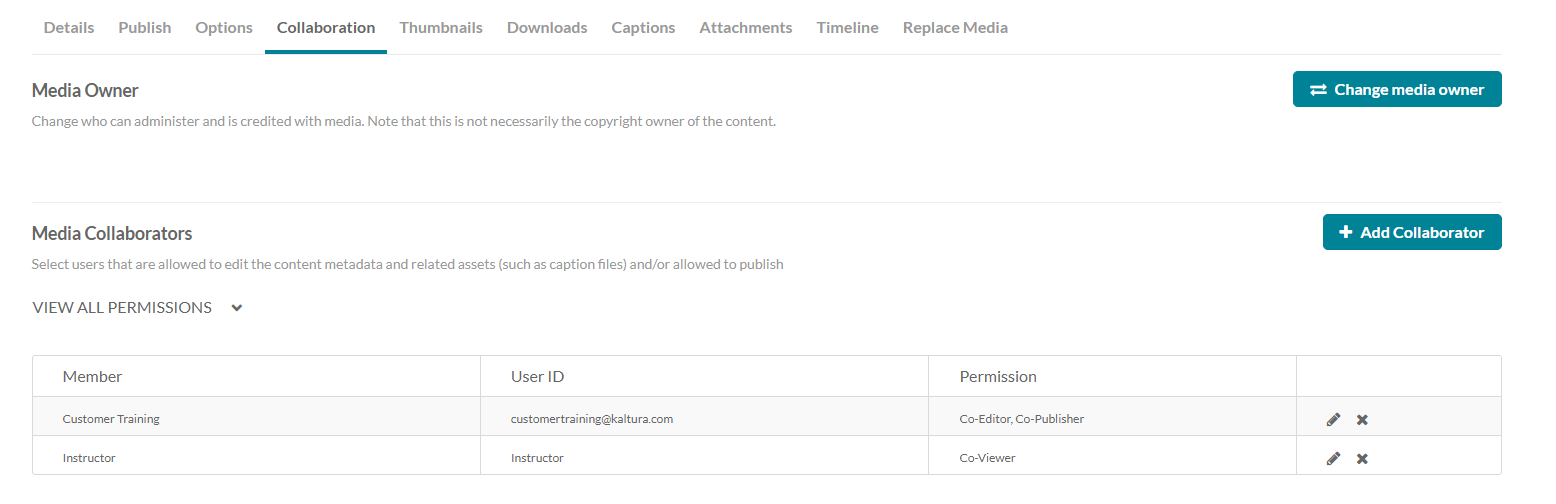
Click Change media owner.
The Change Media Owner window is displayed.
Enter the username or group for the new owner.
Click Save.
My Channels in Kaltura
In Kaltura, a channel is a collection of videos and other media that can be public or restricted in terms of who can view and contribute media to the channel. Channels are useful for aggregating a large number of videos on the same topic or theme, or for sharing a collection of similar or diverse videos with a specific audience.
To create a channel for your course:
- Log into Kaltura MediaSpace, at the upper right, click the area that says Click Here To Login (), and then select . When prompted, log in with your NetID and password.
- Click your name, and then select .
- Click .
- In the "Name" field, enter a descriptive name for your channel. You may also add an optional description and keyword.
- Choose one of the following three privacy options:
- : Select this option if you want other Kaltura users to be able to see and contribute to the media in the channel.
- : Select this option if you want other site users to be able to see the media in the channel. Only invited members can contribute.
- : Select this option if you want access to the media in the channel to be restricted to specific users (for example, the students in your class).
- Review the following two channel options, and check the box(es) to enable them:
- : Select this option if you want to approve content uploaded by others before it is visible to users who can access the channel.
- : Select this option if you want channel viewers to be able to attach comments to videos in the channel.
- To save your channel settings, click .
To add users to your channel:
- Log into Kaltura MediaSpace, at the upper right, click the area that says Click Here To Login (), and then select . When prompted, log in with your NetID and password.
- At the upper right, click your name, and then select .
- Locate the desired channel and click .
- Select the tab.
- Click .
- In the "Add Member" dialog, enter the NetID of the person you want to add, and select one of the following roles:
- : Can view channel content only
- : Can view channel content and add media to the channel
- : Can view channel content, add media to the channel, and moderate channel content
- : Can view channel content, add media to the channel, moderate channel content, and manage the channel.
- Click to add the member to the channel.
- Repeat steps 6 through 8 for each person you want to add to the channel.
- Log into Kaltura MediaSpace, at the upper right, click the area that says Click Here To Login (), and then select . When prompted, log in with your NetID and password.
- At the upper right, click your name, and then select .
- Locate the desired channel and click to open it.
- Click .
- From the "Add Media" page, you have two options:
- Search for and select items from among your existing media. Once you've selected the items you want to add to your channel, click .
- Click to upload a new video or create a new webcam or screen recording.
Create a New or Add to an Existing Playlist
Kaltura playlists are static lists of videos that can be accessed within Kaltura or embedded into Blackboard. For others to view videos in your playlists, the videos must be either unlisted or published to a Kaltura category or channel that your audience has permission to view.
To add items to a new or existing Kaltura playlist:
- On the Kaltura MediaSpace, at the upper right, click the area that says Click Here To Login (), and then select . When prompted, log in with your NetID and password.
- Locate a media item you'd like to add to a new or existing playlist, and then click the item to open it.
From the menu, select .
Note: The menu is located directly beneath the lower-right corner of the media item. If your browser window is too narrow, the menu may not display. If you don't see the menu, increase the width of your browser window.- Create and select a new playlist, or select existing playlists:
- New playlist: To add the item to a new playlist, first create the new playlist by clicking the Create Playlist button. Once it's created, your new playlist will appear under "Select Playlists." Check the box for the new list, and then click .
- Existing playlists: To add the item to any existing playlists, under "Select Playlists," click the check boxes next to the desired playlists, and then click .
When the media item is added successfully to your playlist(s), you'll see a green verification message (e.g., "Media added to selected playlist(s): Playlist 1 , Playlist 2"). You may add additional items to your playlists at any time.
Viewing Media Analytics
Kaltura allows users to view the analytics of individual videos they own or co-own. The details include the video’s performance over time, engagement, access by country, and device overview.
- Navigate to the My Media location in the drop down in the top right.
- Locate the video you'd like to review.
- Click the analytics (
 ) button.
Accessing Zoom Recordings
If you use Zoom to make a cloud recording of your meeting, the Zoom recording will automatically be copied to your Kaltura My Media.
Please note, the video will not start converting in Kaltura until it has full uploaded in Zoom Cloud.
To access the Kaltura copy, please follow to steps above to view My Media in to the Kaltura MediaSpace.
Kaltura How-To Instructions
Kaltura has a wide range of support documentation for Kaltura MediaSpace and can be found here:
Kaltura MediaSpace Go (KMS GO) Mobile App
Android and iOS users can download and use the KMS GO App from the Google Play Store and the Apple App Store.
For additional details, including first time login, please visit the Kaltura MediaSpace Go Mobile App page.
Kaltura Recycle Bin Restore
Kaltura Media Stitching
Need Help? Contact the ITS Help Desk seen days a week by calling 315.443.2677, emailing help@syr.edu, or stopping into 1-227 Center for Science and Technology (Hours of Operation).